

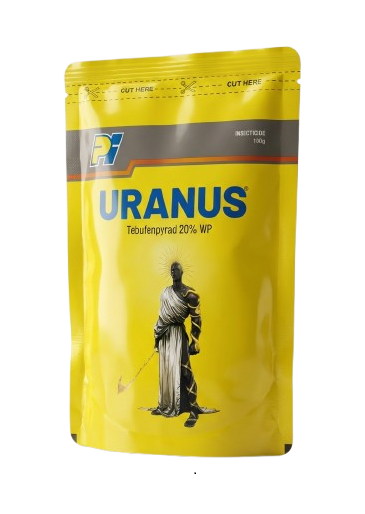
URANUS by PI Industries
Product Details
URANUS by PI Industries -Tebufenpyrad 20% WP
Mites represent a persistent and often invisible threat in various high-value cropping systems, including plantation crops and horticulture. As microscopic pests, they can cause significant physiological damage by piercing plant tissues and draining essential fluids, leading to leaf bronzing, stunted growth, and reduced yield quality. Uranus is a specialized miticide (acaricide) formulated as a 20% Wettable Powder (WP) designed to provide targeted and robust suppression of various mite species. It serves as a vital tool for professional growers seeking to manage complex mite populations while maintaining the overall health and vigor of their crops.
Technical Characteristics and Features
The efficacy of Uranus is based on its active ingredient, Tebufenpyrad (20% WP), a member of the pyrazole chemical class. It is engineered to deliver high-performance control through specialized biological pathways. Key features include:
METI Mode of Action: Acts as a Mitochondrial Electron Transport Inhibitor (METI), specifically inhibiting the complex I of the respiratory chain. This prevents the pests from producing cellular energy, leading to rapid paralysis and mortality.
Broad-Spectrum Mite Control: Highly effective against multiple stages of the mite life cycle, including eggs, nymphs, and adults, ensuring both immediate relief and long-term population suppression.
Wettable Powder Formulation: The WP formulation, composed of natural clay carriers and high-quality surfactants, ensures excellent dispersion in water and uniform coverage on the target foliage.
Strong Contact Activity: Provides rapid knockdown of mites upon contact, which is essential for stopping damage in high-pressure situations.
Vascular Stability: Once applied, the product adheres well to the leaf surface, providing a stable protective barrier against re-infestation.
Usage and Application Suitability
Uranus is primarily utilized for agricultural applications where mite pressure is significant. It is commonly deployed in crops such as tea, chilli, and various fruit and vegetable systems. For optimal results, application should be conducted using calibrated spraying equipment to ensure complete coverage, particularly on the undersides of leaves where mites typically congregate.
Due to its high biological activity, certain environmental precautions are necessary. The product is toxic to honey bees and aquatic organisms; therefore, application should be avoided during active foraging periods or near aquaculture zones. A 24-hour re-entry period is recommended after application to ensure operational safety. Treatment should be initiated at the first sign of infestation or during early population buildup to leverage the product's effectiveness against eggs and nymphs.
Operational Reliability and Outcomes
The integration of Tebufenpyrad 20% WP into a crop protection program provides an effective means of managing mite resistance. Because of its specific mode of action, it serves as an excellent rotation partner for other classes of acaricides. For agribusinesses and farmers, this miticide offers a reliable solution for preserving the photosynthetic capacity of plants and ensuring the aesthetic and nutritional quality of the harvest. By providing consistent and fast-acting suppression of mite outbreaks, it supports sustainable agricultural practices and helps secure the economic viability of the cropping season.